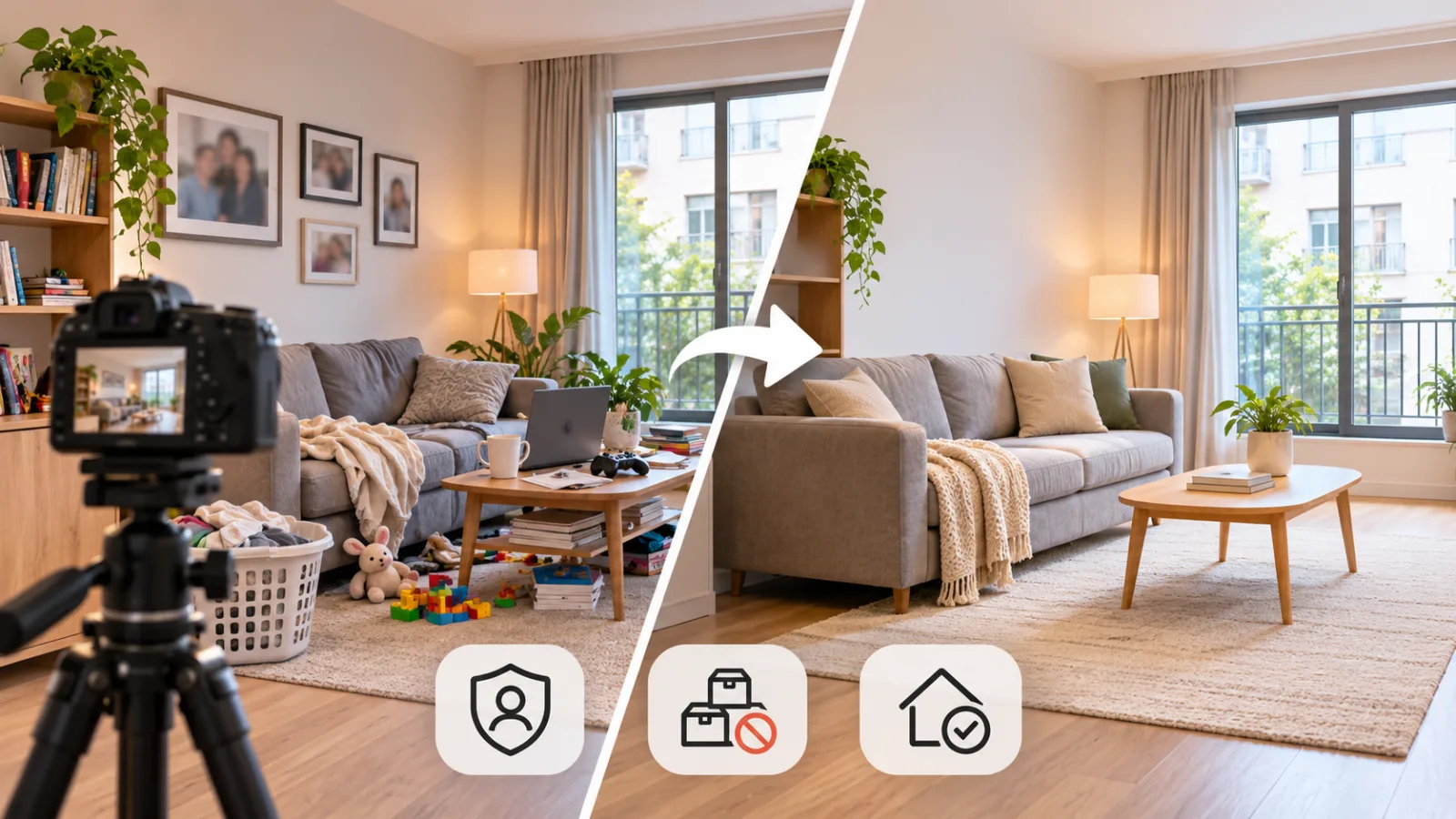
Photographing Tenant-Occupied Properties: How to Get Clean Listing Photos Ethically
Tenant occupied property photography requires balancing two priorities: protecting tenants' privacy and dignity while clearly presenting a home's layout, natural light, and usable space. The best approach combines respectful communication, careful photography, and selective editing to create professional listing images without exposing personal belongings or misrepresenting the property's condition.
Selling a tenant-occupied property creates challenges that rarely arise in vacant homes.
The agent needs attractive photographs. The landlord wants the property marketed efficiently. Meanwhile, the tenant is still living there, often surrounded by furniture, family photographs, work equipment, and everyday possessions.
The solution isn't to demand a perfectly staged home.
It's to build a photography process that respects the tenant, reduces unnecessary preparation, and produces accurate images buyers can trust.
Here's how to do it.
Why Tenant-Occupied Listings Are the Ultimate Photo Challenge
Photographing a vacant property is straightforward compared with photographing someone's home.
In an empty apartment, the photographer controls nearly everything: furniture placement, lighting equipment, camera angles, and shooting time.
In an occupied rental, that control is limited.
Tenants may have no direct financial incentive to help sell the property. They may work from home, have children, own pets, or simply prefer not to rearrange their living space for a marketing campaign.
Their belongings also introduce privacy concerns.
A photograph showing a beautiful living room might accidentally reveal prescription medication, personal correspondence, family portraits, or expensive electronics.
Why poor listing photography matters financially
Online photographs influence how buyers assess properties before requesting viewings.
According to Zillow's 2025 Consumer Housing Trends Report, 26% of prospective buyers ranked high-resolution photographs as their most important listing feature, compared with 33% who prioritized floor plans.
These figures demonstrate the importance buyers place on visual information.
However, they do not establish a specific financial loss from cluttered tenant photographs.
On platforms such as Zillow, Realtor.com, and Rightmove, unclear images may make it harder for prospective buyers to assess the property's layout and condition.
The potential commercial consequences include weaker presentation, additional buyer questions, and the need for replacement photography.
For busy agents, a second photography appointment also creates avoidable scheduling work.
The fundamental difference: you're photographing a home, not a showroom
A rental property is the tenant's living space.
Everyday furniture, children's toys, personal decorations, and household equipment are normal features of an occupied home.
Agents should distinguish between belongings that interfere with understanding the space and those that simply demonstrate ordinary residential use.
A sofa doesn't need removing because it isn't fashionable.
A stack of confidential paperwork, however, should never become part of the public marketing materials.
That distinction forms the foundation of ethical tenant photography.
Setting Expectations: The 48-Hour Diplomatic Preparation Framework
The most effective way to improve occupied-property photography is to prepare before arriving.
A 48-hour preparation framework gives everyone a predictable process without expecting tenants to completely reorganize their lives.
Importantly, 48 hours is an operational recommendation, not a universal legal notice period. Entry rules depend on the jurisdiction, tenancy agreement, and reason for access.
Step 1: Explain the purpose before requesting access
Contact the tenant as early as practical.
Explain who will attend, how long the appointment is expected to last, which rooms need photographing, and where the images may appear.
Clearly distinguish permission to enter from permission to publish photographs containing personal belongings.
These permissions are not necessarily interchangeable.
For example, Queensland's Residential Tenancies Authority explicitly requires written tenant permission before advertising photographs showing their possessions. In New South Wales, new requirements effective September 21, 2026, also require written consent for publication of images showing tenants' or dependent children's belongings.
Requirements differ across jurisdictions, so agencies must check the applicable rules.
Best practice: document photography arrangements and obtain any publication permissions required before advertising begins.
Step 2: Give tenants a realistic preparation request
Avoid sending instructions such as "Please declutter the entire property."
That creates unnecessary pressure.
Instead, ask tenants to secure confidential or valuable belongings while explaining that ordinary furniture and everyday household items can remain.
Offer practical alternatives when preparation is difficult.
For example, the photographer might shoot around a collection of toys or use privacy-conscious digital editing after the appointment.
The tenant should not feel responsible for producing a professionally staged property.
Step 3: Send a tenant-friendly "Shoot Ready" checklist
Provide this checklist approximately 48 hours before the agreed appointment.
Privacy and security
Put away passports, bank statements, bills, and sensitive mail.
Remove prescription medication and medical documents from view.
Turn off computer monitors displaying personal or work information.
Move family portraits, identifiable photographs, and personal certificates.
Secure valuables, keys, access cards, and confidential work equipment.
Simple room preparation
Open curtains or blinds where appropriate.
Clear kitchen countertops of unnecessary loose items.
Move laundry and personal toiletries out of visible areas.
Keep primary walkways accessible.
Identify any rooms or objects requiring special care.
Appointment arrangements
Confirm the agreed time and expected duration.
Identify any spaces excluded from photography.
Discuss arrangements for children and pets.
Confirm who to contact about privacy concerns.
Make clear that the checklist is a request, not an obligation to pack up the tenant's home.
Step 4: Establish boundaries during the shoot
The photographer should respect the agreed scope of access.
Do not open cupboards, drawers, closets, or storage containers without permission.
Avoid moving personal belongings unless the tenant has approved it.
If a room contains sensitive information that cannot reasonably be concealed, skip that angle and discuss alternatives.
A few minutes of respectful communication can prevent lengthy disputes afterward.
Privacy and Legal Red Lines: What Must Never Appear Online
Rental listing photos privacy should be reviewed as carefully as image quality.
The key question isn't simply whether an object looks untidy.
It's whether publishing it could identify someone, reveal private information, or create an unnecessary security risk.
1. Family Portraits, Children's Artwork, and Diplomas
Family photographs can reveal occupants' identities and relationships.
School certificates, personalized drawings, and diplomas may contain children's names, educational institutions, or other identifying details.
These items should generally be removed from the scene, excluded from the frame, or made unreadable before publication.
If a framed portrait is left on a wall, the photographer can adjust the composition to exclude it.
Alternatively, an editor can remove the portable frame digitally when doing so doesn't alter permanent architectural features.
Don't assume that a small photograph is harmless. High-resolution listing images can be enlarged.
2. Personal Documents, Mail, and Work-From-Home Screens
A home office can contain more sensitive information than any other room.
Open laptops, delivery labels, invoices, calendars, and documents may expose personal or commercial information.
Before photographing:
Switch monitors off or display a neutral screen.
Remove visible correspondence.
Check desk surfaces and nearby shelves.
Inspect reflections in mirrors and windows.
Review photographs at full resolution.
For UK-based operations, the Information Commissioner's Office explains that information capable of identifying someone directly or indirectly can qualify as personal data.
In the United States, applicable privacy obligations vary depending on the state and circumstances.
Regardless of jurisdiction, avoiding unnecessary disclosure is the practical starting point.
3. Pet Items, Religious Symbols, and High-Value Personal Electronics
Not every personal possession creates the same privacy concern.
A pet bowl is not automatically sensitive information. Neither is a religious object or television.
However, combinations of belongings may reveal aspects of someone's private life or attract unwanted attention.
For example, visible religious items may reveal personal beliefs. High-value electronics, security equipment, or collections could disclose valuable possessions.
Use proportional judgment.
Remove unnecessary identifying details when practical, but don't treat someone's lifestyle as inherently undesirable.
The objective is privacy and visual clarity, not erasing personal identity for aesthetic reasons.
Physical Staging vs. AI Virtual Decluttering: Choosing the Right Approach
Traditional staging can work well in vacant homes.
In occupied rentals, asking tenants to move furniture, pack decorations, and clear storage areas creates additional disruption.
For agents wondering how to photograph a rented house, a combination of light physical preparation and careful digital editing is often more practical.
Physical staging: best for small, immediate improvements
Physical staging involves adjusting the room before photographing it.
Examples include straightening curtains, repositioning a portable lamp with permission, or clearing loose packaging from a countertop.
Its main advantage is accuracy: the camera records the actual scene after preparation.
Its limitation is the effort required.
Moving heavy furniture or rearranging a tenant's possessions can introduce unnecessary friction and may not be appropriate.
AI virtual decluttering: reveal the room without moving every box
AI-assisted decluttering can remove selected movable objects from photographs and reconstruct the background.
Common examples include laundry baskets, temporary storage boxes, personal photographs, or countertop clutter.
Used selectively, this can help buyers understand wall space, circulation, and room proportions without requiring tenants to reorganize their homes.
An AI virtual decluttering tool to remove personal items while keeping the architecture intact can support this workflow.
However, AI-generated backgrounds are estimates.
A reconstructed wall, floor, or corner must be reviewed against the original photograph. The editing process should not invent architectural details or conceal visible defects.
EstatePic's True-to-Property approach
EstatePic's True-to-Property policy draws a clear distinction between image enhancement and property alteration.
Acceptable editing includes improving exposure, correcting vertical lines, balancing colors, and removing temporary clutter or sensitive personal information.
Unacceptable editing includes concealing cracks, water damage, permanent fixtures, defective surfaces, or other material property characteristics.
The principle is straightforward:
Designed to support truthful property presentation and respectful marketing.
This is an editorial and product-use principle, not a guarantee of legal compliance.
Agents remain responsible for checking their photographs, publication permissions, platform requirements, and local advertising rules.
For UK professionals, Propertymark's photography guidance also emphasizes fair representation and warns against removing fixed features when doing so would mislead consumers.
Decision Table: Handling Tenant Belongings During Photography
The following table provides a practical guide to deciding when to pack, shoot around, or digitally remove belongings.
Belonging Type | Best Action (Pack / Shoot Around / AI Remove) | Reason |
|---|---|---|
Family portraits | Pack or AI remove | Protect identifiable individuals |
Confidential documents | Pack | Prevent disclosure of sensitive information |
Prescription medication | Pack | Protect medical privacy |
Everyday sofa or dining table | Shoot around | Preserve realistic room proportions |
Temporary storage boxes | AI remove, where appropriate | Improve visibility of usable space |
Children's toys | Pack or AI remove | Reduce clutter and identifying details |
Religious objects | Pack with tenant agreement or shoot around | Respect personal beliefs and privacy |
Expensive electronics | Pack or shoot around | Avoid unnecessary security exposure |
Structural cracks or water damage | Keep visible | Preserve accurate property condition |
Built-in fixtures | Keep visible | Prevent misleading representations |
Important: Digital removal is not permission to publish the underlying image. Review consent, data handling, and advertising rules before processing or distributing photographs.
A Practical Photography Workflow for Occupied Rentals
Once the property is ready, a repeatable workflow keeps the appointment efficient.
Prioritize angles that explain the floor plan
Begin with the principal living spaces.
Show where windows, doors, and main circulation routes sit in relation to the furniture.
Keep the camera level to avoid converging vertical lines.
When photographing smaller rooms, avoid extreme wide-angle distortion that makes rooms appear substantially larger than they are.
Capture enough overlapping views to allow an alternative if one photograph contains a privacy-sensitive detail.
Maintain consistent lighting
Use natural light when possible.
Avoid mixing strongly colored artificial lighting with daylight unless necessary.
For interchangeable-lens cameras, shooting RAW gives greater flexibility when correcting white balance and exposure.
A stable tripod can help in darker spaces.
For smartphones, use the main camera and check HDR results carefully, especially around windows.
Editing should improve readability without inventing views or changing the apparent condition of walls and finishes.
Review the full gallery before publishing
A reliable quality-control process has three stages:
Privacy review: identify faces, documents, names, screens, and sensitive belongings.
Property accuracy review: compare edited images against originals to ensure permanent features and defects remain represented.
Publication review: check resolution, captions, disclosures, permissions, and platform requirements.
When practical, let the tenant raise privacy concerns about the proposed images before publication.
This does not replace any formal approval process required by law.
It simply creates a more transparent relationship.
Frequently Asked Questions About Tenant Listing Photos
Do I need written permission from the tenant to publish photos of their rented home?
It depends on the jurisdiction and what the photographs show. Some locations, including Queensland and New South Wales, require written tenant permission before publishing advertising images showing their belongings. Elsewhere, requirements vary. Obtain written permission where required, distinguish access permission from publication permission, and verify applicable local law before advertising.
Can a tenant refuse to let a real estate photographer inside?
Potentially, yes. A tenant's rights depend on local tenancy laws, the lease, notice requirements, and the purpose of entry. Permission to inspect a property does not automatically establish an unrestricted right to photograph it. Agents should arrange access lawfully, avoid forced entry, and seek legal guidance when access is disputed.
Is it legal to digitally remove a tenant's furniture or clutter for a sales listing?
Digital removal is not universally prohibited, but it must comply with applicable advertising, privacy, and consumer-protection rules. Removing temporary clutter may be acceptable when the resulting photograph remains accurate and appropriately disclosed. Never conceal structural defects, permanent features, or conditions that materially affect a buyer's understanding of the property.
Conclusion: Better Photography Starts With Respect
Successful tenant occupied property photography doesn't require a perfectly staged home.
It requires a process that protects tenants, reduces friction, and helps buyers understand the property.
Start by communicating clearly. Ask tenants to secure sensitive belongings rather than completely reorganize their rooms. Photograph the architecture accurately, then use selective editing to improve presentation without altering the property's real condition.
When physical preparation isn't practical, virtual decluttering can provide an alternative for temporary clutter and personal items.
The essential rule remains unchanged: protect the people living in the property while presenting the property itself truthfully.
For real estate professionals, that approach supports more efficient shoots, better working relationships, and listing photographs buyers can evaluate with confidence.
Related guides
Next step: edit your property photos with AI, explore photo editing for real estate teams, or check what real estate photo editing costs.
Sharper listing photos, true to the property.
See pricing