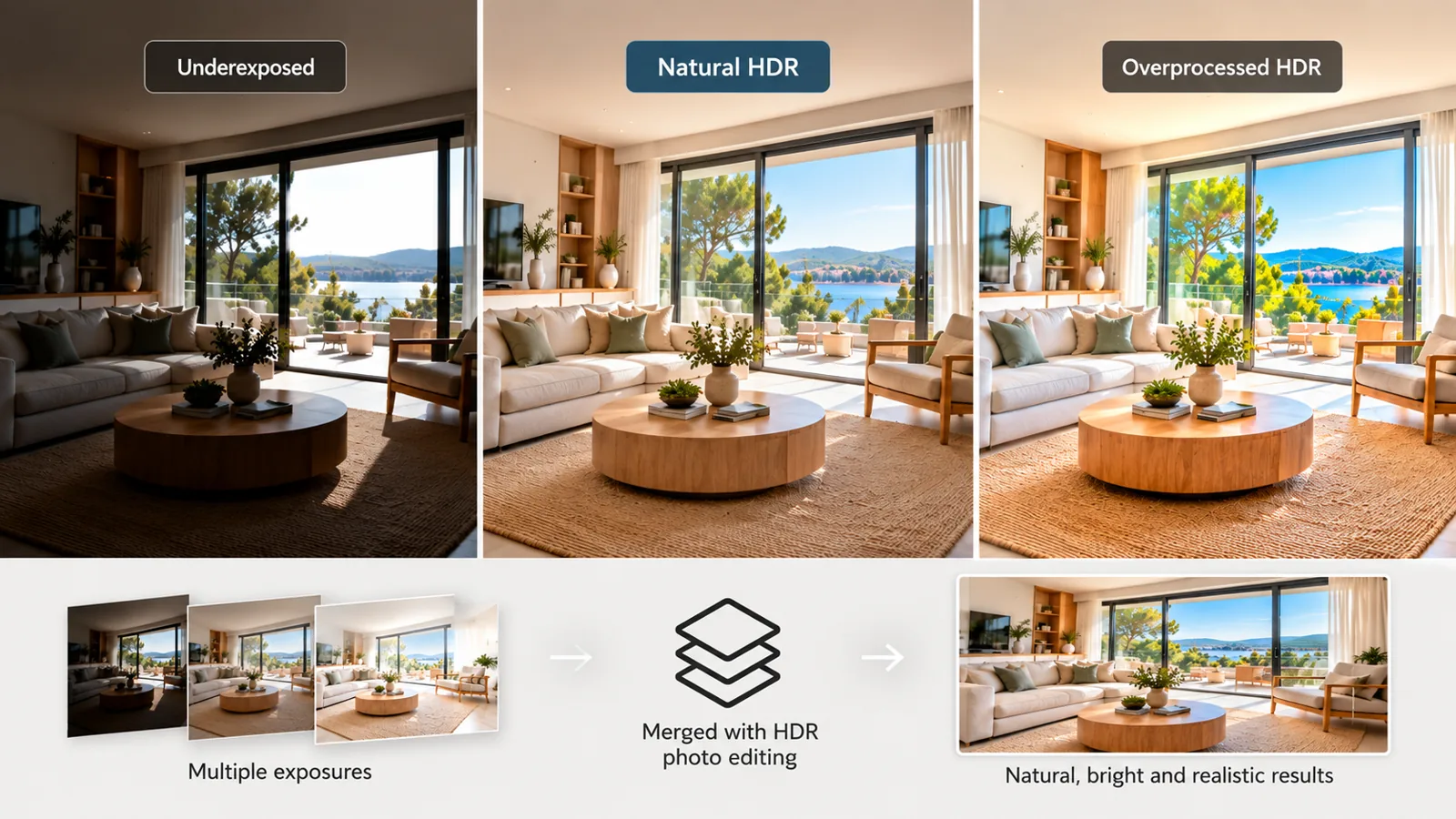
HDR real estate photography is commonly used to solve one of the biggest challenges in property photography: balancing bright windows with darker interiors. Bracketed exposures for real estate photos help capture bright windows and darker rooms. Natural-looking interior HDR photos also depend on restrained editing that avoids HDR overprocessing and preserves the details actually recorded.
When it is done well, HDR can make a room look bright, clean and close to what the human eye actually sees. When it is overdone, however, it can produce unnatural colours, excessive contrast and a heavily processed look.
This guide explains what HDR real estate photography is, when to use it and how to keep the final result realistic.
What Is HDR Real Estate Photography and Exposure Blending?
HDR stands for High Dynamic Range.
In real estate photography, HDR usually involves combining several photos of the same scene taken at different exposure levels.
For example, a photographer may capture:
one darker exposure for the windows;
one normal exposure for the room;
one brighter exposure for shadow areas.
These images are then merged into a single photograph.
The goal is to preserve detail in both the brightest and darkest parts of the image.
Why Is HDR Useful in Real Estate Photography?
Interior photography often contains a very wide range of light.
A living room may be relatively dark while the view through a large window is extremely bright.
A single exposure can struggle to capture both correctly.
If you expose for the room:
the interior looks good;
the windows may become completely white.
If you expose for the exterior:
the view remains visible;
the room may become too dark.
HDR helps balance these extremes.
This is particularly useful for:
rooms with large windows;
properties with scenic views;
interiors with strong backlighting;
darker rooms facing bright outdoor areas.
How Does HDR Real Estate Photography Work?
A typical HDR workflow begins with exposure bracketing.
The camera captures several images from exactly the same position, usually using a tripod.
One image may be underexposed, one correctly exposed and another overexposed.
A photo editor or automated processing tool then combines the useful information from each exposure.
The resulting image can preserve:
window detail;
shadow detail;
natural colours;
interior brightness.
The quality of the final result depends heavily on how the images are blended.
The Main Problem with HDR: Overprocessing
HDR has a bad reputation in some areas of real estate photography because it is easy to push too far.
Common problems include:
unrealistic colours;
heavy saturation;
dark halos around windows;
grey or muddy whites;
excessive local contrast;
unnatural shadow recovery;
flat-looking rooms.
These effects make the image look processed rather than photographed.
For a property listing, that can reduce trust.
The goal should not be to create the most dramatic image possible. It should be to represent the property clearly and attractively.
How to Create Natural-Looking Interior HDR Photos
1. Start with Well-Exposed Bracketed Photos
HDR cannot completely fix poor photography.
Use stable, well-composed source images with:
straight verticals;
consistent framing;
correct focus;
appropriate exposure bracketing.
A tripod is especially useful because all exposures need to align precisely.
2. Avoid Extreme Shadow Recovery
It can be tempting to brighten every dark area until the entire room has the same luminosity.
But real rooms contain natural shadows.
Removing all of them can make the image look flat.
Keep some depth and contrast so that the room still feels realistic.
3. Window Pulls: Protect Window Detail Without Making It Artificial
One of the main benefits of HDR is recovering views through windows.
However, the exterior should not look dramatically darker or sharper than the interior.
The transition between the room and the window should feel natural.
A realistic window view supports the property. It should not look pasted into the image.
4. Keep Colours Neutral
Strong HDR processing can create exaggerated colours, particularly in:
wooden floors;
blue skies;
green plants;
warm artificial lighting.
Check the white balance carefully.
Walls that are white in reality should not appear orange, blue or grey unless the lighting genuinely creates that effect.
5. Do Not Overuse Clarity and Contrast
Clarity and local contrast can make an image appear sharper, but too much can create a harsh look.
This is especially noticeable around:
furniture edges;
windows;
wall corners;
architectural details.
Real estate photos usually benefit from a clean, balanced finish rather than an aggressive HDR style.
HDR vs Single-Exposure Real Estate Photography
HDR is not always necessary.
A single exposure may be enough when:
the room is evenly lit;
windows are not significantly brighter than the interior;
there is no extreme contrast;
the camera already captures enough dynamic range.
HDR becomes more useful when the lighting difference between the interior and exterior is significant.
The right approach depends on the scene rather than a fixed rule.
HDR vs Flash Photography
Professional real estate photographers sometimes use flash instead of, or in combination with, HDR.
Flash can help control interior lighting and colour more precisely.
However, it also requires:
additional equipment;
more setup time;
experience balancing flash and ambient light.
HDR is often easier to integrate into a fast workflow, especially for estate agents or teams photographing multiple properties.
Both techniques can produce excellent results when used correctly.
Can You Create HDR Real Estate Photos with a Smartphone?
Yes.
Modern smartphones already use computational photography and HDR techniques automatically.
When photographing a room with bright windows, the phone may combine several exposures without the user noticing.
This can work well for everyday listings (see our guide to taking listing photos with a smartphone), but the result still depends on:
camera position;
available light;
lens choice;
composition.
AI-assisted image editing can also help refine exposure, colours and perspective after the photo is taken, for example with AI real estate photo editing for listings.
HDR and AI Real Estate Photo Editing
AI can automate some of the same corrections traditionally handled through manual HDR workflows.
Depending on the software, AI-powered editing can help with:
exposure balancing;
window recovery;
colour correction;
shadow adjustment;
perspective correction;
consistency across a complete property shoot.
For an estate agency, the main advantage is speed.
Instead of manually processing each photo in a traditional photo editor, a complete set of listing images can be adjusted using a more consistent workflow.
The key is to avoid automated processing that makes every image look excessively bright or artificial.
Is HDR Real Estate Photography Misleading?
HDR itself is not inherently misleading.
Its purpose is often to reproduce a wider range of light than a single exposure can capture.
Problems arise when editing goes beyond correcting photographic limitations and begins to alter the property itself.
For example, HDR should not be used as an excuse to:
hide defects;
change permanent features;
make rooms appear larger;
replace views;
create unrealistic lighting conditions.
A useful principle is simple:
improve how the camera represents the property without changing what the property actually is.
Common HDR Real Estate Photography Mistakes
Before publishing an HDR image, check for:
unnatural saturation;
overly bright shadows;
halos around windows;
grey whites;
inconsistent colour temperature;
exaggerated exterior views;
distorted vertical lines;
excessive sharpness.
If the image immediately looks “HDR”, the processing may be too strong.
The best HDR real estate photography often looks like a well-exposed natural photograph.
When Should You Use HDR?
HDR is particularly useful when:
interior and exterior brightness differ significantly;
large windows dominate the frame;
a property has important views;
rooms contain deep shadows;
you want consistent exposure across an entire listing.
Avoid using heavy HDR processing simply because the software makes it available.
Use it when it solves a real photographic problem.
Conclusion
HDR real estate photography is a powerful technique for balancing bright windows and darker interiors.
The best results are subtle.
Good HDR should preserve details, improve exposure and make the room easier to understand without creating an artificial or overprocessed look. Read also: EstatePic vs AutoHDR: Which Real Estate Photo Editing Tool Is Right for You?.
Whether you use bracketed exposures, a traditional photo editor or AI-assisted image editing, the objective remains the same: produce bright, consistent and natural property photos that stay faithful to the real space.
See also: HDR real estate photo editing services: what to expect and how to choose.
Related reading: basement real estate photography: how to light dark and windowless rooms.
Next step: edit your property photos with AI, explore photo editing for real estate teams, or check what real estate photo editing costs.
Sharper listing photos, true to the property.
See pricing